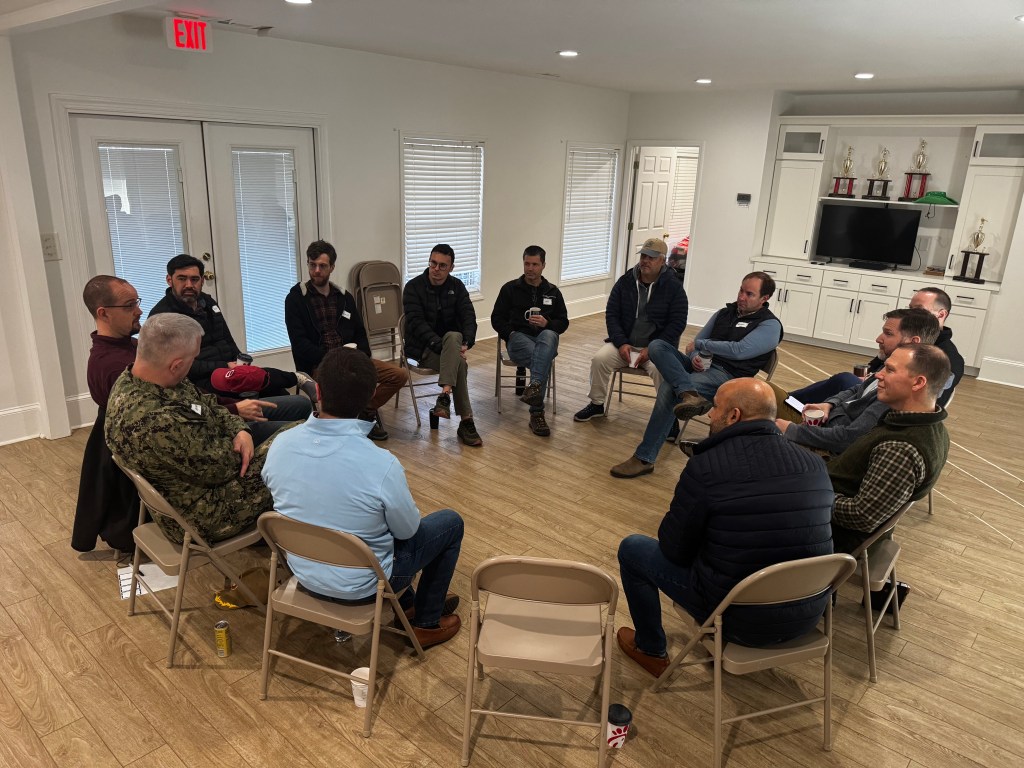
Before we ever talked envelopes, chores, Roth IRAs, or compounding interest, one dad opened our time with a line that landed like a weight in the room:
“The Lord preserveth the strangers; he relieveth the fatherless and widow…” (Psalm 146:9, KJV)
He pointed out something easy to miss: Scripture presents “fatherless” and “widow” as conditions God relieves. In other words, when a man is absent, something essential is missing—something God sees and moves toward with mercy. That is not a puffed-up view of fatherhood; it’s a sober calling. We are not optional accessories in a home. We are meant to be present, steady, and faithful—especially in the slow, ordinary work of forming children.
Then we prayed for what every father needs: to live from the overflow of God’s love rather than our own strain. Because if our kids are going to learn a healthy relationship with money, they first need to see a healthy relationship with God.
Previous Week In Practice
A few dads reflected on last week’s theme: grace and faith, especially through Abraham’s long wait for God’s promise.
The “takeaway” was not academic. It was painfully practical: Abraham believed, then got impatient and tried to make God’s word happen through his own effort (the “Hagar strategy”). That phrase has a bite because we all recognize it: God said it… but I’m going to force it.
In fatherhood, the Hagar strategy shows up when we panic about outcomes and grasp for control:
- We try to “manufacture” character with pressure instead of cultivating it with consistency.
- We confuse “getting results” with walking in the Spirit.
One dad summarized the contrast well: living in the flesh is “I’ll make this happen in my power.” Living in the Spirit is trusting God enough to obey patiently, even when you can’t see the results yet (Romans 4:18–21).
That connects directly to money. Many of us were never discipled into patience—especially financial patience. We learned shortcuts, debt-normalization, impulse buying, and quiet anxiety. If our children are going to inherit something better, they need more than rules; they need a father who models faith over grasping.
Dallas Willard put it crisply: “Grace is not opposed to effort; it is opposed to earning.” (The Great Omission) The point isn’t passivity—it’s the posture of the heart. We teach our kids effort (work, saving, giving), but we refuse the soul-disease that says, “I deserve more than God has provided.”
Kids and Money: Start With Stewardship, Then Get Practical
We acknowledged we could do many Fridays on theology of money—God’s ownership, generosity, contentment, and the heart. And we should. Scripture is blunt: “Where your treasure is, there your heart will be also” (Matthew 6:21). Jesus treats money as a spiritual diagnostic, not a neutral tool (Luke 16:10–13).
But this morning leaned toward practical methods that help kids feel reality, not just hear lectures.
1) The envelope system: giving, saving, spending
One dad described starting around age eight or nine with physical envelopes:
- 10% giving
- 20% saving
- 70% spending
The genius is that it’s concrete. Kids at this age are still developing abstract thinking. They do far better when money is visible and divided into purpose. It turns “be generous” into “here is what generosity looks like.”
This also builds a crucial theological category: giving is not what we do with “extra.” It’s firstfruits (Proverbs 3:9), worship (2 Corinthians 9:6–8), and training the heart away from entitlement.
2) No allowance: work is tied to money
Another practice: no automatic allowance. Instead, there are:
- Family chores (you do this because you live here; love serves)
- Paid jobs (specific tasks tied to earned money)
Examples were simple: $1 per bag of trash taken to the bin, a few dollars to clean the microwave, bigger jobs like mowing. The aim wasn’t a perfect system; it was a worldview: money comes through work, not demand.
That lines up with Scripture’s dignity of labor (Colossians 3:23–24) and the warning against idle entitlement (2 Thessalonians 3:10–12). It also trains gratitude: I contributed; I didn’t just receive.
3) “Make the invisible visible”: the household budget table
Several dads talked about a powerful exercise: withdraw a month’s pay in small bills (one used $5s), then create budget stacks—mortgage, utilities, tuition, insurance, retirement, taxes, savings, giving, travel.
Kids watch the piles shrink. A light bulb turns on: “So that’s what it takes to run a home.”
One dad did it with equal piles first, then explained each necessity: water, electricity, transportation, school. Another dad followed up with simple pie charts to show percentages. For older kids, this sparked better questions later: “Do we own the car?” “Are we still paying this off?” That’s maturity growing in real time.
A side discussion mattered: how much do you share? Some dads avoid exact salary numbers when kids are young (because they may blurt it out). Others share rounded figures, focusing on costs and categories rather than income. The principle is wisdom: “Let your speech always be gracious… seasoned with salt” (Colossians 4:6). Teach without feeding pride or fueling comparison.
4) Contentment and the “Sprite problem”
One story captured the heart issue: a teenager who used to say, “Can I get a Sprite? It’s $3.” Later she connected the dots: repeated small spending can quietly steal from bigger joys—travel, meaningful experiences, long-term goals.
This is a father’s discipleship moment. We’re not just teaching math; we’re teaching desire. Paul’s secret wasn’t a bigger budget. It was learned contentment (Philippians 4:11–13). Money discipleship fails when it’s only tactics and never formation.
5) Compounding interest: hope, math, and freedom to serve
One dad walked his 11-year-old through a compounding example—babysitting income, investing half, watching future values rise. The point wasn’t to create a junior day-trader; it was to give a child a vision of time, patience, and possibility.
Then came the deeper line: if you build stability early, you may gain freedom later—not just to relax, but to serve. That’s a profoundly Christian frame: money is not ultimate, but it can remove burdens that limit obedience.
Other dads added guardrails for teens: consider a Roth IRA if the child has earned income; consider what accounts mean for financial aid; and be careful about tax rules around children’s investment income (often called the “kiddie tax”). For example, student assets generally impact financial aid calculations far more than parent assets (student assets can be assessed around 20% versus a much lower rate for parent assets). And kiddie-tax thresholds can change by year (for 2025/2026, some summaries describe the first portion of a child’s unearned income being sheltered by a standard deduction, with higher amounts taxed progressively and then at the parent’s rate). (For anything specific, talk to a tax professional.)
The heart beneath the habits: humility vs entitlement
A “nugget” from Dave Ramsey’s Smart Money Smart Kids came up: the antidote to entitlement is humility. That resonates biblically: humility is reality—seeing God as Owner, ourselves as stewards, and everything as gift (James 1:17; 1 Peter 5:5–7).
If your child learns “I deserve,” money becomes a master. If your child learns “I’ve been entrusted,” money becomes a tool.
Actionable steps for the week
- Open with Psalm 146:9 and James 1:27. In one minute, tell your kids: “God cares for the fatherless; dads matter; we want to steward our role.”
- Start the three-envelope system this week. If your child gets money (gift, small jobs), physically divide it: giving/saving/spending. Keep it tangible.
- Clarify two lists of chores.
- “Family chores” (no pay): dishes, tidy, help sibling—because love serves.
- “Paid jobs” (earned): trash to the bin, clean microwave, mow, wash car.
- Do the “budget table” exercise (20–30 minutes). Use cash, play money, or printed stacks. Make categories visible: housing, utilities, food, insurance, school, giving, savings, fun. Ask: “What surprised you?”
- Teach sales tax with a real receipt. Next time you buy something small, show subtotal vs total. Let them feel the difference.
- Create one “experience fund” jar. Tie daily choices to future joy: “We skip small impulses so we can do meaningful things together.”
- Have a “money manners” talk. One sentence rule: “We don’t announce what our family makes or spends to others.” Explain privacy without shame.
- For teens: run a compounding interest demo. Use a simple calculator and their real earning potential. Keep the tone: patience, consistency, freedom—not hype.
- Add a generosity practice that costs them something. Let them choose a cause (church, compassion work, a family in need). Teach giving as worship.
- Schedule one dad-to-dad coffee this month. Your kids don’t only need your strategies; they need your stability. Brotherhood strengthens both.
- Watch for the “Hagar strategy” in yourself. Where are you grasping—fear, pressure, comparison? Confess it. Return to faith-filled effort, not anxious control.
- Bless your child out loud. Put your hand on their shoulder and pray: “Lord, make you a wise steward. Give you contentment. Make you generous and free.”
When fathers take money seriously as discipleship, we don’t just raise kids who can budget—we raise sons and daughters who can resist entitlement, embrace stewardship, and walk with God patiently in a world that screams, “Now.”
 Trinity Dad's Coffee
Leave a comment