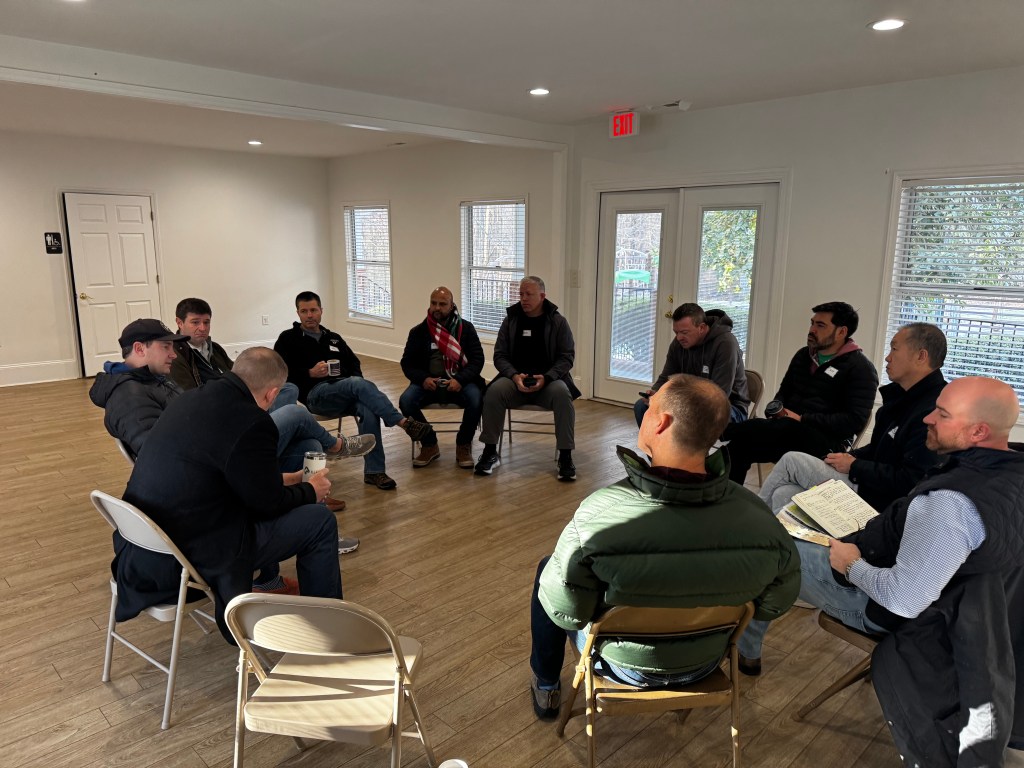
A Trinity Dads reflection on Galatians 3 and the subtle drift into “God-points” parenting
Most fathers don’t wake up intending to drift. We start with good desires—lead our kids well, love our wives well, walk with God sincerely. But somewhere between carpool chaos, bedtime meltdowns, headlines, and our own insecurities, we can quietly slide from life with God into life for God—trying to “finish by the flesh” what only the Spirit can sustain.
Galatians 3 puts words to that drift.
Previous Week In Practice
The first part of our meeting was men sharing how they attempted to practice last week’s conversation—real life, real interruptions, real opportunities.
1) The “podcast attempt” and the car-meltdown moment
One dad shared how he queued up a John Piper podcast in the car with the hope of sparking conversation with his boys. The content was solid, but the moment turned into something every father recognizes: the podcast ended right as they pulled in, and the conversation never really happened. Even better—midway through, one son melted down because he had procrastinated Scripture memory and suddenly panicked.
It became an unplanned discipleship moment: “This is procrastination. We’ve known about this since January.” The dad handed over the phone: “Read your Scripture. Your brothers will listen.”
That’s fatherhood: your plan doesn’t always work, but God still gives you a moment to shepherd. The lesson wasn’t “always play longer podcasts.” The lesson was more practical: pick smaller, bite-sized content that fits the ride—and be ready for the real ministry moment to be the child’s heart, not your curriculum.
“Teach them diligently…” (Deuteronomy 6:7) often looks like teaching in the car, in the interruption, and in the meltdown—not just in the quiet moment you imagined.
2) Creativity and the doorway to worship
Another dad revisited the group’s earlier discussion about creativity. He asked his kids (8 and 5) what they think “creates creativity.” Their answers surprised him: they described elaborate “worlds” they play in—Lego world, bad-guy world, transitions between worlds—an entire inner landscape he hadn’t known existed.
He wisely saw the bridge: if our children are natural creators, we can gently point them to the Creator. “In the beginning, God created…” (Genesis 1:1). When we honor our kids’ imaginative worlds, we’re not just entertaining them—we’re learning their hearts, and then connecting their wonder to worship.
3) Discernment and calling out spiritual manipulation
A third dad mentioned listening to short “Red Pen Logic” clips, including content about exposing public misuse of “prophecy” and spiritual manipulation. That led to an important reminder: it can be biblical to name public deception, especially when it harms people. Jesus confronted religious leaders who burdened others while posturing as holy (Matthew 23). Paul warned about false gospels (Galatians 1:6–9).
Discernment isn’t mean-spirited cynicism. It’s protective love. For fathers, that includes guarding our homes from spiritual confusion while keeping our posture humble, prayerful, and anchored in Scripture.
Galatians 3: The Drift From Spirit to Flesh
The group centered on Galatians 3:1–14. Paul comes in hot: “You foolish Galatians… Did you receive the Spirit by works of the law, or by hearing with faith?” (Galatians 3:1–2). Then the line that hit many of us:
“Having begun by the Spirit, are you now being perfected by the flesh?” (Galatians 3:3)
That question isn’t only about circumcision debates. It’s about the universal religious temptation: to start with grace and then try to maintain your life with God through self-powered performance.
What is “the flesh”?
The group offered a few complementary angles:
- The flesh as self-rule: my will over God’s will—my “kingdom” operating independently.
- The flesh as natural human power apart from God: doing even “good” things without reliance on grace.
- The flesh as inward impulses and unsanctified desires: not only sexual temptation, but also reputation, achievement, wealth, status, control.
This fits Scripture’s broader picture: “the desires of the flesh… and pride of life” (1 John 2:16). The flesh isn’t only “bad cravings.” It’s also good deeds done for the wrong god—the god of self.
A key distinction emerged:
- The world pressures you from the outside (messages, applause, outrage cycles, status scripts).
- The flesh rises from the inside (self-salvation projects, control, “God-points,” fear-based striving).
And behind both is a spiritual battle that Scripture takes seriously (Ephesians 6:12).
Abraham: Faith Isn’t Clean; It’s Relational
Paul roots his argument in Abraham: “Abraham believed God, and it was counted to him as righteousness” (Galatians 3:6; Genesis 15:6).
One brother highlighted the narrative context: Abraham’s faith wasn’t abstract belief. It was a lived relationship—God speaks, Abraham responds. God calls him to leave identity and security (Genesis 12). God promises a son against all odds (Genesis 15–17). Then God asks for Isaac (Genesis 22), pushing Abraham into the kind of trust that can’t be faked.
And yet, Abraham still stumbles—Hagar and Ishmael happen because Abraham tries to “make God’s promise happen” through human strategy (Genesis 16). That’s “finishing by the flesh” in story form.
This is deeply comforting for fathers: the “man of faith” is also a man who panicked, grasped, and tried to control outcomes. The difference is not perfection; it’s returning to God.
The Curse, the Cross, and Why Paul Keeps Quoting the Old Testament
A striking observation: Paul repeatedly references the Old Testament to make his case. He’s not offering vibes; he’s showing continuity. The law pronounces a curse on all who fail to do everything written (Galatians 3:10; Deuteronomy 27:26). Then Paul shows the shock of the gospel:
“Christ redeemed us from the curse of the law by becoming a curse for us.” (Galatians 3:13)
The group connected this to Deuteronomy’s statement that the one hung on a tree is under a curse (Deuteronomy 21:23). Jesus absorbs what we could not carry. This isn’t “God helps those who help themselves.” It’s God helps those who cannot help themselves. (Romans 5:6–8)
For a father trapped in performance, this matters: your standing with God is not your track record. It’s Christ.
“Faith vs Works” and the Order That Saves You
The group raised the apparent tension: Paul emphasizes faith apart from works (Galatians 3), yet James says “faith without works is dead” (James 2:17). The resolution is the order:
- Paul: works can’t earn salvation.
- James: real faith will produce fruit.
Or put simply: we are not saved by works, but we are saved for good works (Ephesians 2:8–10). Works are not the root; they are the fruit.
One brother cautioned wisely: even “faith” can be twisted into a self-powered project—“I’ve got to muster up faith.” But Galatians points to faith as a conduit: “so that by faith we might receive the promised Spirit” (Galatians 3:14). The goal is communion—oneness with Christ—living from the Spirit, not performing for God.
This has direct parenting application. Many of us teach our kids “do right things,” but Galatians asks: what’s the motivation? Are we training behavior management, or are we forming hearts that live loved?
Parenting Application: Teaching Deep Things Without Creating Legalism
Late in the conversation, a father asked the practical question: these are deep topics—how do we address them with our kids at different ages?
One dad shared a real example: he talked with his third-grade daughter about lying and named the temptation as spiritual warfare—an impulse to distort reality and self-protect. That opened dialogue (even if, amusingly, it led to kids role-playing “Satan” with toys for a week). It’s a reminder: kids will often misunderstand before they understand. That’s okay. We keep guiding.
The father’s posture matters: we’re not trying to make our children “perform Christian.” We’re trying to help them learn to bring their hearts into the light (John 3:20–21), confess, receive grace, and grow.
Action Steps for This Week
1) Replace “God-points” with a simple prayer of dependence
Once per day, say:
- “Holy Spirit, I can’t do today in my own strength. Lead me.” (Romans 8:13)
Then name one area where you’re self-powering: reputation, control, money anxiety, lust, anger, productivity.
2) Do one “car conversation” with a shorter tool
Pick a 3–6 minute clip (not a 45-minute episode). Ask just two questions:
- “What stood out to you?”
- “What do you think God is like because of that?”
Close with 10 seconds of prayer together. (Deuteronomy 6:7)
3) Practice “Creator bridge” parenting
During playtime this week, watch your child’s imaginative world for 2 minutes without correcting. Then say:
- “You’re really creative. God made you that way. What do you think God enjoys creating?” (Genesis 1:1; Psalm 19:1)
4) Identify your “Hagar strategy”
Write down one promise or hope you’re trying to force through manipulation or anxiety. Ask:
- “Where am I trying to make this happen without God?”
Then surrender it: “Lord, teach me to wait and obey.” (Psalm 143:10)
5) Put a guardrail on the “flesh pathway” you know is vulnerable
If lust is the battle: choose one concrete boundary (not vague intention):
- remove an app, install accountability, no-phone bathroom rule, screen curfew, or a daily 5-minute “eyes on Christ” reset (Matthew 5:8; Galatians 5:16).
Make it specific and measurable for 7 days.
6) Teach your kids the difference between “doing good” and “being loved”
At bedtime once this week, say:
- “God doesn’t love you because you were good today. God loves you because He is good.” (Romans 5:8)
Ask: “What would it feel like to rest in that?”
7) One act of faith that becomes fruit
Choose one small act that expresses trust, not performance:
- apologize first, give generously, serve unnoticed, speak truth gently, or pray with your wife.
Not to impress God—because you’re already loved. (Ephesians 2:10)
If Galatians 3 had a fatherhood headline, it might be this: Don’t raise your kids (or live your life) as if the Spirit got you started but you have to finish alone. Begin by the Spirit. Continue by the Spirit. And let your home become a place where grace is not a concept—it’s the atmosphere.
 Trinity Dad's Coffee
Leave a comment