Most fathers don’t set out to parent in opposition to their wives. But life has a way of pulling a couple into parallel lanes—busy schedules, different stress thresholds, different family histories, different instincts. Then a child (especially a sharp one) notices the gap: “Mom said yes.” “Dad said no.” “But you always…” And suddenly you’re not just raising kids—you’re defending territory.
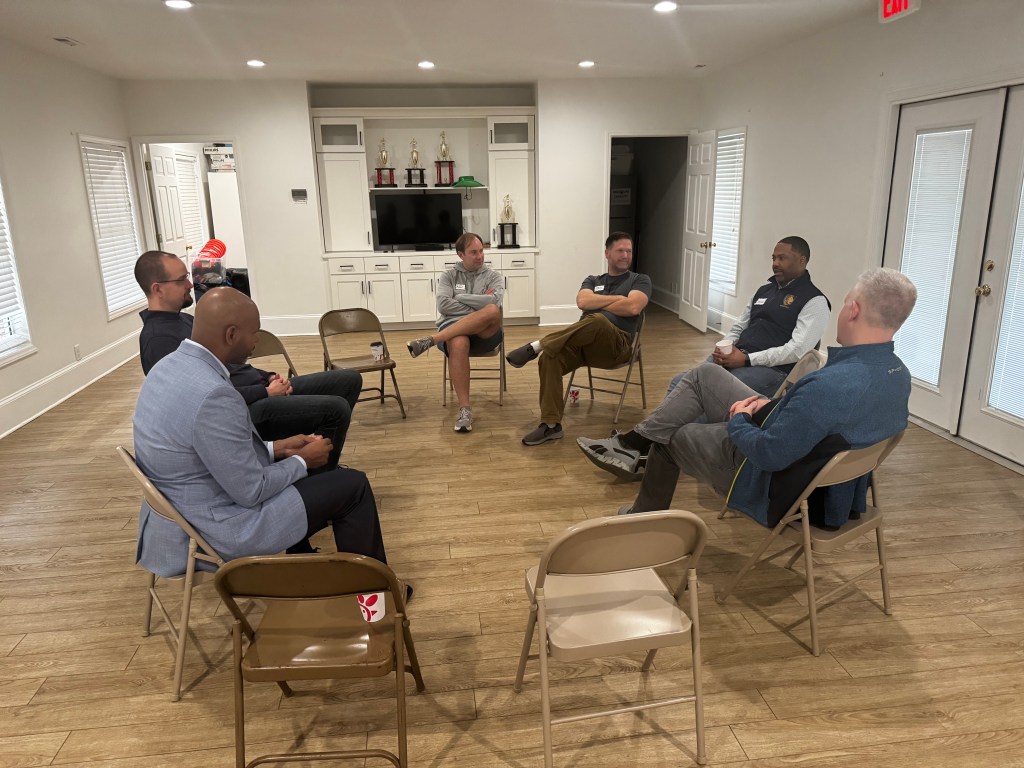
This week’s discussion centered on unity with your wife in raising kids, not as a vague ideal, but as a practiced, fought-for, prayed-for reality. Unity is not sameness. It’s not that you both react the same way, lead the same way, or carry the same responsibilities. Unity is shared direction, shared heart, and a shared front—the kind that gives children safety, clarity, and a picture of Christlike love.
“Grace is not opposed to effort; it is opposed to earning.” —Dallas Willard
Unity is grace-fueled work. You don’t earn it. You practice it.
Previous Week In Practice
Last week’s topic was money and kids—teaching stewardship, generosity, wise planning, and even the long-view power of compounding growth. One dad reflected that the conversation helped him see just how different families can be: some grew up seeing nothing about finances and want to do the opposite, while others feel their kids aren’t mature enough yet to carry that knowledge. The range of perspectives was a gift because it surfaced a key parenting reality: our defaults are usually inherited.
One father shared a helpful urgency: with an oldest child nearing high school, the window feels short—“we only have four years to get that squared away.” That’s a wise wake-up call. Kids don’t drift into wisdom about money. They’re discipled into it. Scripture frames money as a heart issue and a stewardship issue: “Honor the Lord with your wealth” (Proverbs 3:9), and “One who is faithful in very little is also faithful in much” (Luke 16:10). Those principles don’t appear at 18 by accident; they are formed over time in the home.
The deeper theme under last week’s money talk was this: your marriage is the primary classroom. Kids learn stewardship not only from budgets, but from watching how mom and dad agree, sacrifice, prioritize, and trust God together.
Two Kinds of Unity Every Family Needs
This week’s conversation clarified that “unity” has at least two layers:
- Unity of philosophy: Are we aligned on what we’re trying to produce in our children? What do we believe about discipline, responsibility, screen time, respect, faith formation, friendships, and character?
- Unity of presentation: Do our kids experience us as a united front, or do they see us as two competing authorities?
Scripture calls husbands and wives to more than coexistence. It calls for oneness: “The two shall become one flesh” (Genesis 2:24), reaffirmed by Jesus: “What God has joined together, let not man separate” (Mark 10:9). Parenting will test that oneness constantly. Unity isn’t proven in the easy seasons. It’s forged in the daily decisions.
Your Family of Origin Is Talking—Even When You Don’t
A major thread in the conversation was family of origin. One dad described his upbringing in a Christian home where, looking back, his father carried the majority of decision-making weight. His wife’s upbringing was almost the reverse—her mother carried strong leadership influence. When two stories like that merge into one marriage, “unity” becomes a real project.
Another father described being a pastor’s kid, grounded in church life, while his wife came from a fractured home and was raised largely by grandparents. Another shared how his parents’ generation tended to be secretive about finances and burdens, while his marriage now includes a wife shaped by a strong maternal household with no father present. These stories matter because they quietly define what “normal” feels like.
The Bible anticipates this. Genesis 2:24 says a man leaves father and mother and holds fast to his wife. Leaving doesn’t mean dishonoring your parents. It means breaking the power of unconscious patterns so your marriage becomes its own covenantal culture.
A practical takeaway from the group was simple and profound: name the models you inherited. Ask:
- What did my home teach me about authority?
- What did I learn about conflict?
- What did I learn about affection?
- What did I learn about money, discipline, and emotional expression?
You cannot unify what you refuse to examine.
Shared Leadership Doesn’t Have to Mean Equal Roles
Several dads used “60/40” language—recognizing that leadership and responsibility may not be perfectly symmetrical, and may differ by topic. One father described clear division of labor: his wife leads in medical and child-health areas; he leads in other areas; together they “average out” over time.
That’s not failure. That’s wisdom. Unity doesn’t require that you both do the same tasks. Unity requires that you both agree on the mission and honor one another’s contributions. Scripture frames this as mutual humility and service: “Submit to one another out of reverence for Christ” (Ephesians 5:21), and “Do nothing from selfish ambition… but in humility count others more significant than yourselves” (Philippians 2:3).
Practices That “Fuse” a Marriage Over Time
The most concrete strategies shared weren’t complicated. They were repeatable.
1) “Prayer breaks” in real life
One dad described pausing mid-day or mid-conversation to take his wife’s hand and pray—one minute, three minutes, not performative, just real. That simple act does two things: it recenters the home under God, and it reminds both spouses, “We’re on the same team.”
Scripture is blunt: “Pray without ceasing” (1 Thessalonians 5:17). And Jesus ties agreement to prayer in a powerful way (Matthew 18:19). A quick prayer break can interrupt escalation and restore direction.
2) Shared inputs, shared language
Another father described the unifying effect of reading or listening to the same things—books, podcasts, devotionals—so husband and wife gain common categories and vocabulary. Ideally, Scripture is the primary shared input (Deuteronomy 6:6–7). But shared formative content can also reduce friction: fewer “I heard this” vs. “I heard that” collisions.
3) More fun, more connection
The group referenced a “four habits” framework: have more fun together, pray together, make eye contact when you talk, and increase affectionate touch. Whether you love the neuroscience explanation or not, the pastoral point is clear: a disconnected couple struggles to stay united under pressure. Parenting stress will always reveal the strength (or weakness) of your friendship with your wife.
Scripture supports the heart of this: “Rejoice in the wife of your youth” (Proverbs 5:18). Joy is not optional fuel—it’s marital glue.
Unity Shows Up When Your Teen Tries to Pull You Apart
One father shared about parenting a highly observant teen who remembers everything: “Dad, you said this. Mom, you said that.” That’s not just annoying—it’s a gift. It exposes where alignment is needed.
He also shared a moment of conviction: in a heated exchange with his 17-year-old, he felt his own upbringing rise up—memories of harsh physical intimidation from his father. In that moment, his wife’s intervention prevented escalation, and he recognized the calling to respond differently.
This is where Christian fatherhood becomes deeply spiritual warfare—against the flesh, against generational sin, against reactive anger.
Scripture gives the playbook:
- “Be quick to hear, slow to speak, slow to anger” (James 1:19–20)
- “A soft answer turns away wrath” (Proverbs 15:1)
- “Fathers, do not provoke your children, lest they become discouraged” (Colossians 3:21)
The father’s insight was striking: if a three-year-old says “I hate you,” we don’t exile him; we understand development and emotional overflow. Teens are different, but they are still developing. The call is not permissiveness—it’s regulated strength. A united couple can provide boundaries without becoming adversaries.
Actionable Steps for the Week
1) Do a 30-minute “Family of Origin Summit” with your wife
Pick one evening. Ask each other:
- What did your parents do well?
- What did you promise yourself you’d never repeat?
- Where do you feel “triggered” in parenting—and what childhood story is underneath it?
Close by praying: “Lord, redeem our family line. Make our home a place of peace and holiness.”
2) Establish a “Two Yeses or One No” for kid-facing decisions
Agree on a simple policy:
- Either mom and dad agree: Yes
- If mom says “no” and dad says “yes” (or vise-versa): it means NO until mom and dad talk about it.
3) Start a daily 3-minute prayer break (hands held)
Do it once a day for a week—before work, at lunch, after bedtime—any time. Keep it short:
- Thank God for one thing.
- Ask for wisdom for one parenting issue.
- Ask for unity and patience.
4) Create a weekly 15-minute “Parent Huddle”
Same time every week. Agenda:
- What’s one win with the kids?
- What’s one problem we need alignment on?
- What’s one decision coming this week (discipline, schedule, screen time, friends)?
Write the decision down so you’re consistent.
5) Choose one shared input for the next two weeks
Pick one: a short Bible plan, a parenting chapter, or a podcast series. The goal is not information; it’s shared language. Discuss one takeaway together each week.
6) Practice “slow anger” with your teen using a script
When your teen escalates, try:
- “I hear you. I’m not ignoring you.”
- “I need a minute to respond wisely.”
- “We’ll talk again in 10 minutes.”
Then return. Follow through calmly. This trains both you and your child.
7) Add one connection habit (fun, eye contact, touch)
Pick just one this week:
- 20-minute walk together
- No-phone conversation with eye contact after kids are down
- A long hug before leaving the house
Small practices compound into unity.
A united marriage is one of the greatest gifts you can give your children. Not because you never disagree, but because they watch you disagree with humility, repair quickly, pray honestly, and move forward as one. That kind of home doesn’t happen by accident. It happens when a husband decides, by the grace of God, to fight for unity—first with Christ, and then with his wife—for the sake of the family God has entrusted to him.
 Trinity Dad's Coffee
Leave a comment