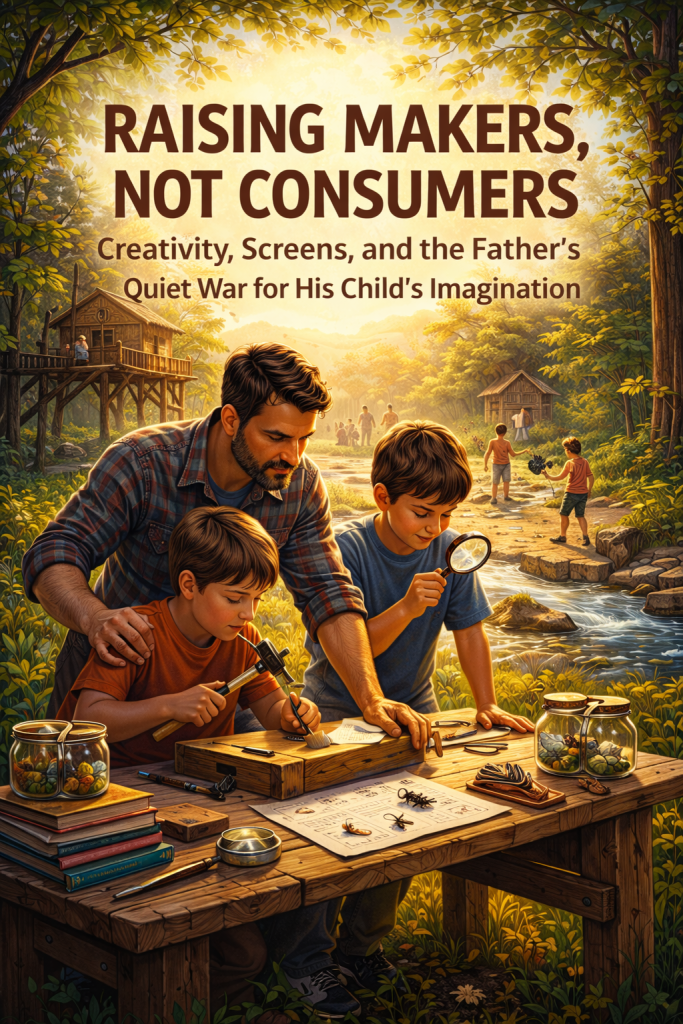
A theme kept surfacing in the conversation—sometimes stated plainly, sometimes felt underneath the jokes and the sidebars: our children are being trained to consume. Not just content, but experiences, ideas, even identity. And if Christian fathers don’t respond intentionally, the default current of the culture will do the training for us.
What struck me wasn’t that the dads were “anti-technology.” Most of the men were thoughtful and realistic. Some even work in innovation or psychology. The real concern was deeper: screens don’t just fill time; they form souls. And creativity—true creativity—requires a kind of inner space that endless content steadily erodes.
Scripture gives us language for this. “Do not be conformed to this world, but be transformed by the renewal of your mind” (Romans 12:2). Conformity often happens quietly, over time, through repeated inputs. And today, those inputs are increasingly chosen by an algorithm—not by parents, not by the child, and certainly not by the Spirit.
The Hidden Cost: When the Algorithm Disciples Your Kids
One dad summarized it well: “Don’t let the algorithm choose for you what you’re taking into your soul.” That sentence is a warning—and it’s also a strategy.
The men described how short-form video pushes kids into a “doom cycle” of sameness: more of the same content, more stimulation, less thought, less boredom, less depth. Even when content isn’t explicitly “bad,” it can still be spiritually numbing—a steady drip of distraction, consumerism, and shallow reward.
Jesus’ words are blunt and clarifying: “The eye is the lamp of the body… if your eye is unhealthy, your whole body will be full of darkness” (Matthew 6:22–23). In other words: what you allow in shapes what grows inside. The algorithm isn’t neutral because formation isn’t neutral.
Creativity Requires Space—and Space Requires Limits
A repeated conviction in both conversations was that creativity doesn’t bloom in constant stimulation. It blooms in unstructured time, boredom, constraints, and wonder.
One family shared a practice that sounds almost too simple: when a child wanted to look up something on a screen (a Pokémon image, a DIY video), the father said no—not because the desire to learn was wrong, but because the screen was becoming a reflex. The child was pushed back toward memory, books, trial-and-error, and confidence.
That is fatherhood wisdom: sometimes the loving move is not “Here, I’ll get it for you,” but “Try. Struggle a little. Build the muscle.”
This aligns with how Scripture talks about maturity: “Solid food is for the mature, for those who have their powers of discernment trained by constant practice” (Hebrews 5:14). Practice requires friction. Screens remove friction. They often remove the very conditions where creativity grows.
Wonder Is the Gateway Drug to Creativity
Several dads described what might be the most underutilized tool in Christian fatherhood: awe. Not hype. Not entertainment. Awe.
Nature walks. A microscope. Close-up photography of insects. Exploring how dirt filters water. Teaching kids to see ordinary creation as miraculous. One dad said it plainly: “It’s fostering wonder.”
This matters spiritually, not just psychologically. “The heavens declare the glory of God” (Psalm 19:1). Creation is not only scenery—it is training. It trains attention. It trains gratitude. It trains the mind to notice. A child who learns to notice becomes a child who begins to imagine, connect, and create.
And it’s hard to notice anything when you’re constantly being interrupted.
Monoculture and the Decline of Original Thought
One observation was unsettling but accurate: the internet tends to create a monoculture. Kids everywhere are exposed to the same trends, the same formats, the same humor, the same music patterns. Even pop music analysis was referenced—how lyrical and musical complexity has decreased while uniformity has increased.
Whether every detail is perfectly measured or not, the direction is obvious: platforms reward what spreads fastest, not what is truest or most beautiful. This is why fathers must be curators—not just of content, but of inputs that shape taste.
Philippians 4:8 becomes a father’s filter: “Whatever is true… honorable… just… pure… lovely… commendable… think about these things.” That verse isn’t only for quiet time. It’s for dinner playlists, road trips, books on the shelf, what we laugh at, what we normalize, what we reward.
Boredom Is a Gift (Even If Your Kids Hate It)
The dads kept circling the same question: Should we provide activities, or should we let kids be bored? The answer wasn’t a hard rule—it was a direction.
Many shared a common experience: if you remove screens and don’t immediately replace them, kids may be frustrated for 10 minutes… and then suddenly Legos appear, drawings begin, games emerge from salt shakers and Splenda packets. Boredom doesn’t kill kids. It often resurrects their imagination.
This is consistent with a Christian view of formation: we don’t grow only through delight; we grow through limit. We learn self-control through “no.” We learn creativity through “not yet.” We learn endurance through waiting.
Even adults know this. One dad admitted doomscrolling is his own addiction. The conversation got honest: kids won’t choose well if dads are modeling dependence.
“Be imitators of me, as I am of Christ” (1 Corinthians 11:1) is not a slogan—it is an invitation to examine what our children are actually watching us worship.
Technology and AI: Tool, Shortcut, or Teacher?
The breakout-only transcript added a thoughtful nuance: AI can feel both creative and not-creative. A dad shared how he used AI image generation for Christmas cards: he still felt creative—prompting, refining, directing. But then he created a song for his daughter “in two seconds,” and it felt more like a shortcut than creation.
This distinction matters: tools can assist creativity, but they can also replace the slow process that forms skill.
Genesis gives the foundational identity: humans are made in the image of a Creator (Genesis 1:27), and therefore creating is part of our calling. But tools should serve that calling—not hollow it out. The goal isn’t to raise kids who can “produce” quickly. The goal is to raise kids who can think, imagine, discern, and build—with God.
One dad made a strong spiritual point: “The more you’re disconnected from the Creator, the less creativity you can produce.” That may not be mechanically true in every instance, but it is deeply true in direction: creativity that is severed from God tends to drift toward emptiness, imitation, or exploitation. Creativity connected to God tends to move toward meaning, beauty, order, and love.
The Father’s Role: Guardrails + Green Lights
The conversation landed in a practical tension: fathers can’t merely say “no screens.” We must also provide “yes” paths—hands-on projects, outdoor exploration, shared music, camps, tools, forts, engines to tinker with, chores that involve building something real.
This is Deuteronomy fatherhood: “You shall teach [these words] diligently… when you sit… when you walk… when you lie down… when you rise” (Deuteronomy 6:7). Formation is not an event. It is a way of life.
And yes—sometimes it means getting off the couch at 10 p.m. when your son is dreaming out loud about building something that flies. Not every time. But enough times that he learns: My dad takes my imagination seriously.
Action Steps: A Practical Fatherhood Plan for Building Creativity
1) Establish a “No Algorithm” policy for your home
This week, define which algorithm-fed feeds are off-limits (or heavily restricted):
- YouTube Shorts / TikTok-style feeds
- autoplay recommendations
- endless-scroll apps
Replace with curated inputs:
- albums (full albums, not singles)
- physical books
- one pre-selected documentary or series episode at a time
2) Create “boredom windows” (and don’t rescue them)
Pick two 30–60 minute blocks per week where:
- screens are off
- parents do not provide activities
- kids must figure it out
Use one phrase consistently: “Boredom is a gift.”
Then hold the line kindly.
3) Build one “wonder ritual” into your rhythm
Choose one:
- a weekly nature walk with a “notice 5 things” challenge
- microscope night (even cheap ones work)
- “creation curiosity” questions at dinner (one per night)
Tie it to Scripture: Psalm 19:1 or Romans 1:20.
4) Replace screen-help with skill-building (1:1 swap)
When your child asks for a screen shortcut (“Can I look up a DIY?”):
- Ask: “What’s the first step we could try without it?”
- Give them a book, a tool, or a material
- Let them attempt it for 15 minutes before any screen is considered
5) Start a father-child “maker project” (4 sessions)
Pick one simple project and schedule four short sessions:
- fix a small engine / replace a part
- build a fort
- make a birdhouse
- design a paper glider progression
- build a small dam at a creek
Put it on the calendar. Creativity grows in committed time, not good intentions.
6) Model your own “screen repentance”
Tell your wife and kids your plan (they’ll keep you honest):
- “I’m limiting my phone use in the mornings.”
- “If you see me scrolling, call me out.”
Then implement one visible habit:
- phone stays in a drawer until breakfast is done
- no scrolling while watching a show
- one day a week “digital Sabbath” for the family
7) Use AI as an apprentice, not a replacement
If you use AI:
- require your kids to first sketch/write their own idea
- then use AI to refine, expand, or compare options
- end by asking: “What did you create that AI couldn’t?”
Tie it to Philippians 4:8 as the evaluation grid.
8) Curate a “beauty pipeline” for your kids
Build a short list of inputs that train taste:
- music with real instrumentation (jazz, classical, jam bands, global music)
- art museum trips where you ask: “What do you see? What do you feel?”
- biographies of courageous people
Don’t announce “we’re building creativity.” Just feed beauty.
9) Anchor creativity to communion with the Creator
Once a week, pray this with your child:
- “God, you are the Creator. Teach us to see your world.”
- “Give me ideas that are good and loving.”
- “Help me use my hands to build what blesses others.”
This makes creativity a spiritual practice, not a personality trait.
 Trinity Dad's Coffee
Leave a comment