There is a reason the church has historically leaned on Q&A as a primary tool for passing down the faith. Long before most families owned a Bible—and long before kids could carry a phone—Christians formed belief and character through catechesis: guided instruction, often in question-and-answer form. In the early centuries, new believers (catechumens) were taught the faith and observed in their way of life over an extended period before baptism.
That same wisdom still fits modern fatherhood: kids learn best when truth is repeated, embodied, and attached to daily life—“when you sit… when you walk… when you lie down… and when you rise” (Deuteronomy 6:7). A short “theological Q&A” on the way to school can become one of the most powerful discipleship habits in your home.
Previous Week In Practice
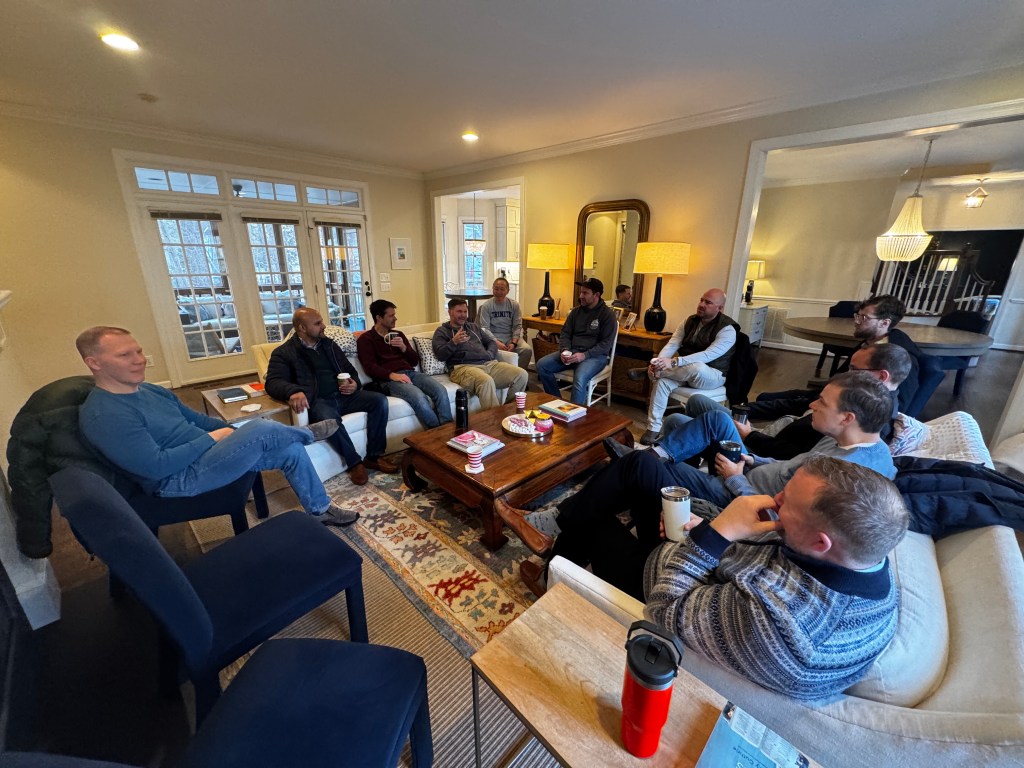
Before the group moved into theology, several dads shared how they practiced last week’s theme: cultivating creativity and building a home environment where kids learn to initiate, persist, and create.
- Letting kids be bored (without rescuing them). One dad practiced patience when the kids came in from playing in the snow and hit the familiar line: “What can I do?” Instead of filling every minute, he made space for them to problem-solve, choose, and create.
- Making room for invention. Another dad saw his kids build an improvised “contraption” across the house using blocks, books, pillows, and even a laundry basket. When they got stuck, he paused work to engage—helping them think rather than simply fixing it for them.
- Inviting kids into boundaries and responsibility. One father was impressed by his daughter’s elaborate build (the result of learning and applying a skill), and he chose to call a family meeting so the older kids could propose what responsible use would look like in their house.
- Banning “I don’t know” as a stopping point. One dad introduced a simple family rule: you can say “I don’t know,” but it must be followed by a comma—“I don’t know, but my best thinking is…” That small shift trains courage, curiosity, and effort.
- Conversation prompts at the dinner table. A dad recommended the Tales conversation card decks as an easy, repeatable tool: a few questions each dinner, and suddenly the whole family is talking again.
These practices are not about controlling kids. They’re about forming kids—teaching them to persevere, imagine, speak, and relate in ways that build strength and maturity.
Why Q&A Has Always Mattered: A Brief Catechism Story
Catechism is not a “Catholic word.” It’s a church word—shared broadly across Christian traditions—because it works. The Q&A method compresses big doctrine into memorable language that can be rehearsed, discussed, and lived.
During the Reformation, catechisms flourished as a way to shape households in the basics of Christian belief and practice. Martin Luther designed his Small Catechism explicitly for home instruction—framing it as something the head of the household should teach “in a simple way.” Likewise, the Westminster Shorter Catechism became a beloved tool for families and churches, opening with a question many Christians still remember:
Q: What is the chief end of man?
A: Man’s chief end is to glorify God, and to enjoy Him forever.
A catechism isn’t meant to replace the Bible; it’s meant to train the mind and heart to think biblically, quickly, and joyfully—especially when life gets loud.
Definitions to Run Through With Your Children
This meeting centered around a “Willard-style” set of definitions—short theological questions designed for real life. Dallas Willard was famous for insisting that spiritual growth depends on clarity: if we don’t know what we mean by “grace,” “kingdom,” or “discipleship,” we will drift into religious noise instead of transformation.
1) Kingdom
Q: What is your kingdom?
A: The range of your effective will—where what you want can actually happen.
For a child, that might be: my body, my room, my choices, my words. This gives you a concrete discipleship target: what part of my “kingdom” is not yet submitted to God?
Q: What is God’s kingdom?
A: The range of God’s effective will—where what God wants is actually done.
That connects directly to Jesus’s prayer: “Your kingdom come, your will be done” (Matthew 6:10).
2) Where is God’s kingdom?
A key discussion point was honesty: God is sovereign, but rebellion is real. That’s why discipleship is not theoretical. The question becomes: Will my little kingdom become a place where God’s will is gladly done?
3) Discipleship
A working definition offered in the meeting:
Discipleship is being with Jesus to learn what he would do if he were you—living your life.
This echoes Jesus’s own posture: “I do nothing on my own… but only what I see the Father doing” (John 5:19).
4) Sanctification
The group named sanctification as “becoming more like Christ over time.” A father added the practical angle: when he neglects Scripture and prayer for several days, he can feel the drift. That’s not shame—that’s awareness. Sanctification is not instant maturity; it is Spirit-empowered formation (Philippians 2:12–13).
5) Character
One definition landed strongly:
Character is what you do without thinking.
In other words: your reflexes. Your default tone. Your automatic response under pressure. The group noted an important nuance: we also shape character by repeated choices—over and over—until righteousness becomes “normal.”
6) Grace
This was the hinge point:
Grace is not only forgiveness. Grace is God acting toward you with power.
A definition shared was: grace is God’s power enabling you to do what you cannot do in your own strength.
Willard’s famous line captures the balance: “Grace is not opposed to effort, it is opposed to earning.”
That matters for dads because you are always training your children in a gospel instinct: either “I earn love by performance,” or “I receive love and then I learn to live in it.”
The meeting also raised a provocative question: if grace is God’s enabling presence, was grace needed before the fall? The answer leans toward yes—because humanity was created for dependent partnership with God (Genesis 1:28; Deuteronomy 8:3).
Why Solitude, Silence, and Fasting Keep Showing Up
The group discussed why some teachers emphasize solitude, silence, and fasting as unusually powerful disciplines—especially in modern Western life.
The simplest reason: these disciplines remove the false supports (noise, appetite, control) that keep us from noticing how much we need God. They move God from the margins back to the center.
- Solitude: being alone with God without managing anybody else.
- Silence: not filling space with words—so you can listen.
- Fasting: practicing dependence—“man does not live by bread alone” (Deuteronomy 8:3).
A dad connected silence to love: asking more questions, talking less, giving others the center stage. Another tied this to Luke 10 (Mary and Martha): being with Jesus is not laziness; it’s priority (Luke 10:38–42).
Someone also noted how time with God reshapes a man’s “face”—a nod to the biblical theme of God’s presence changing us (Numbers 6:24–26; 2 Corinthians 3:18).
Detailed, Actionable Steps for Dads
1) Start a “Car Catechism” rhythm (5–8 minutes)
Pick one question per week. Ask it daily on the way to school.
- Mon–Tue: Ask the question; let them answer freely.
- Wed: Give a short definition.
- Thu: Ask for an example from their day.
- Fri: Ask how it connects to Jesus.
Suggested starter set:
- What is your kingdom?
- What is God’s kingdom?
- What is discipleship?
- What is grace?
2) Use age-based answers (same truth, different language)
- Kindergarten–2nd: “My kingdom is what I can control: my body, my words, my room.”
- 3rd–6th: “My kingdom is where my choices work. God’s kingdom is where God’s way is done.”
- 7th–12th: “My kingdom is the range of my effective will—my agency. Discipleship is learning to align my will with God’s.”
3) Train initiative with one sentence
Replace “I don’t know” with:
“I don’t know, but my best thinking is…”
Use it for homework, conflict, boredom, and faith questions.
4) Practice one discipline of subtraction each week
Choose one:
- 10 minutes of silence (no talking; no inputs).
- A half-day mini-solitude (walk, woods, or a quiet room with Scripture).
- A simple fast (adults: a meal; kids: dessert for an evening), pairing it with prayer for dependence.
5) End the day with one kingdom question
At bedtime ask:
- “Where did you run your kingdom well today?”
- “Where did you feel God inviting you to do it differently tomorrow?”
Pray one sentence: “Father, let your kingdom come in that place.”
 Trinity Dad's Coffee
Leave a comment