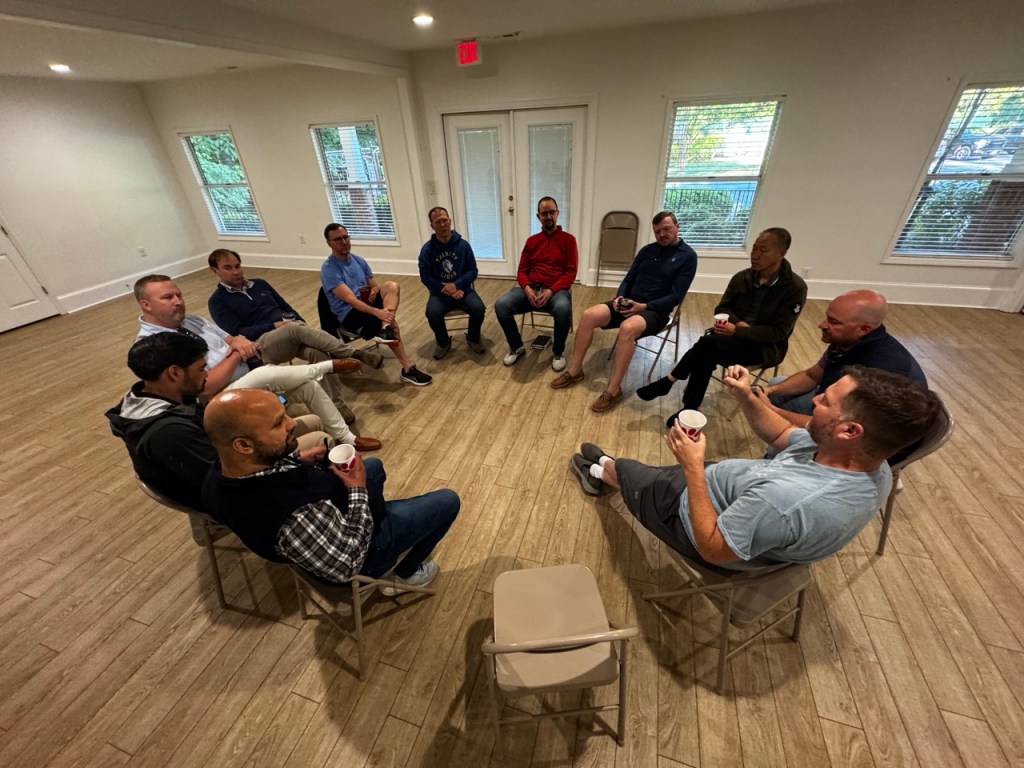
There’s a tension every Christian father feels — the pull between protecting your children and preparing them for the world. This week, our dads group wrestled with one of the most practical and profound questions we face: how do we raise brave, capable, confident kids without being reckless or fearful? The conversation was rich, honest, and Christ-centered, and the takeaways are ones every dad needs to hear.
Previous Week In Practice
Before diving into the main discussion, several dads shared how they’ve been putting faith into action through a simple but powerful ministry: assembling and distributing care bags for people on the street. One dad shared how he includes a small New Testament in each bag alongside water, a snack bar, and wet wipes. He even places small tabs inside the Bible, marking key passages like the book of Romans so anyone who opens it can quickly find the gospel message.
His daughter helps hand the bags out, and he admitted the experience raises hard questions. Sometimes it’s the same person at the same intersection. Sometimes the person looks healthy and able-bodied. Sometimes a woman shows up where you’d only ever seen men before. But as he put it, you can’t really make that judgment — you just have to trust that God is going to put the right thing in their heart.
Another dad recalled a time years ago when he stopped and offered to buy dinner for a man outside a restaurant. That one meal turned into dinner for the man’s brother too. They sat together and just talked. It was a beautiful moment of hospitality, but it also raised the question: how far do you take that step? Especially now, with kids and a family to consider, the calculus of generosity becomes more complicated. His wife once told him after a similar encounter, “I did not feel safe.” That honesty reshaped how he thinks about engaging strangers — not with less compassion, but with more wisdom.
These stories set the stage perfectly for the morning’s topic, because they illustrated something every father must learn to navigate: the difference between avoiding risk entirely and stepping into it with prayer, discernment, and faith.
The Main Conversation: Appropriate Risk and Raising Independent Kids
The discussion was sparked by recent bike accidents in the community — sobering reminders that the physical world carries real danger. But as one dad pointed out, there’s a critical flip side: “At what point does the prevention of anything bad happening become the cost of not living a life?”
Scripture tells us that God has not given us a spirit of fear, but of power, love, and a sound mind (2 Timothy 1:7). Yet we live in a culture that feeds us every tragedy through seven different apps on our phones before breakfast. The dads talked openly about how the constant stream of bad news — from mom groups, news alerts, and social media — has shifted the collective risk calculation far toward fear. One dad referenced Jonathan Haidt’s The Anxious Generation, noting that statistically, the physical world isn’t significantly more dangerous than it was in the 1970s and 80s. What’s changed is our awareness and our anxiety.
Several fathers recalled their own childhoods — riding bikes miles from home, crossing highways to get to a flea market, being gone all day with nothing but a phone call to check in every few hours. The freedom they experienced built confidence, street smarts, and resilience. And yet most admitted they struggle to give their own children even a fraction of that same independence.
One dad shared a powerful observation: we over-index on restricting freedom in the physical world while often allowing almost unlimited access in the virtual world. “I’m going to protect you by keeping you in the house,” he said, “but then hand them a screen where the danger is gradual and invisible.” The irony is striking. A bike accident produces an immediate, visible consequence. The damage from unchecked screen time and social media is slow, cumulative, and harder to see — but arguably just as dangerous to a child’s soul and development.
The conversation kept returning to a central truth: our kids will face the world whether we prepare them for it or not. As Proverbs 22:6 reminds us, “Train up a child in the way he should go; even when he is old he will not depart from it.” Training implies exposure, practice, and graduated challenge — not isolation.
The Boy Who Drew Strength from the Truck
One father shared a story he’d written down a couple of years ago, waiting for the right moment to bring it to the group — and this was that morning. His son Isaac, who is eight now, was about six at the time. They’d had lunch together and driven to a park. His daughter Addie was asleep in her car seat, so dad stayed in the truck and encouraged Isaac to go out and play in the park by himself.
Isaac went. He explored for a bit and then came back to the truck to report what he’d found. He told his dad there was a path he’d followed, but it went to a place where dad couldn’t see him anymore. He’d checked it out, but it was kind of scary, so he came back. His dad looked at him and told him something every boy needs to hear from his father: “You’re a boy, and one of the cool things about being a boy is that you get to explore and find things. You’re a brave and capable guy, and you can do things by yourself.”
Isaac went back out. This time he ran a little farther down the path and came back beaming. Dad excitedly asked him what he’d seen. Isaac told him he found two leaf piles but didn’t jump in them because they were off the path. Dad told him it’d be okay if he played in the leaves.
He came and went one or two more times after that, always traveling a little further, always coming back with new things to report. And here’s the part of the story that landed hardest with the group — the punchline that makes the whole thing worth telling. Isaac told his dad, in his own words, that he would get strength at the truck, and then he’d go back out. He came back to the truck, and he left it with renewed strength. That was a six-year-old’s way of describing something profound: his father’s presence was his source of courage. The truck wasn’t a cage keeping him in. It was a refuge that sent him out. Every time he returned, he was refueled — and every time he left, he went farther than before.
The last time, Isaac was gone for close to ten minutes. Dad got out of the truck to see where he was. He spotted his son a good ways off, holding a stick, just banging around in the woods — completely in his element. Dad quietly snuck back into the truck so Isaac wouldn’t know he’d been watched. Isaac eventually made it back on his own and told his dad all about the adventure. Dad said he could visibly see his son’s sense of independence growing right in front of him.
That image — the boy who draws strength from the truck and then goes out — is a picture of exactly what a father is supposed to be. Not the one who walks the path for his child. Not the one who fences off the path entirely. But the steady presence at base camp who says, “You’re brave. You’re capable. Go see what’s out there — and I’ll be right here when you get back.” And it’s a picture of our Father in heaven, too. Psalm 46:1 calls God “our refuge and strength, a very present help in trouble.” Isaac drew strength from the truck. We draw our strength from the Lord — and then He sends us out.
This is the unique role of a father. Research and experience both confirm that dads are typically the ones who encourage appropriate risk-taking while moms tend to emphasize safety. Both instincts are good and God-given. The push and pull between husband and wife is not a flaw — it’s the design. As one dad put it bluntly, “You better be sure nothing happens if you let the kid do something the wife didn’t want to happen.” That healthy tension, navigated with communication and mutual respect, produces the calibrated freedom kids need.
The group also discussed the concept of risk mitigation versus risk elimination. One dad, drawing from his military background in operational risk management, encouraged fathers to teach their kids to think through risk rather than simply avoid it. “There’s no such thing as zero risk,” he said. “You can fall off your bed.” The goal isn’t to eliminate all danger — that’s impossible and paralyzing. The goal is to identify the most likely negative outcome and make a plan for it. Want your kid to ride to the gas station? Teach them to stay in the ditch off the main road. That’s mitigation, not elimination — and it builds a child’s ability to think critically and act wisely.
Perhaps the most convicting moment came when one dad admitted his tendency to “parent with immediacy” — expecting his kids to just know how to do things because they’ve watched him do them a thousand times. “I don’t give them the opportunity to do it, put it in the wrong place, and then patiently correct them,” he said. “I just jump to the end.” Patience is its own form of risk-taking for a dad. It means watching your child struggle, resist the urge to take over, and trust the process. Ecclesiastes 3:1 tells us there is a time for everything — and sometimes it’s the season to let your child fail in small ways so they can succeed in big ones later.
The conversation closed with a powerful spiritual anchor. One dad reminded the group that risk is inherent to the Christian life itself. If God is calling you into something, the riskiest thing you can do is disobey. Joshua 1:9 says, “Have I not commanded you? Be strong and courageous. Do not be afraid; do not be discouraged, for the Lord your God will be with you wherever you go.” That promise isn’t just for us — it’s for our children too. And part of our job as fathers is to teach them to believe it.
Another dad added a practical and deeply spiritual encouragement: be prayerful about it. “When you have to turn your kids over to do something, pray before the event. Trust in the Lord’s protection. We often forget to do that.” Even something as simple as praying before the morning drive to school is an act of faith that acknowledges we are not in control — God is. And that truth should free us, not freeze us.
Actionable Steps for Dads This Week
Create a “Freedoms List” for each child. Sit down with your wife and write out age-appropriate freedoms your child should be earning between now and age eighteen. Include everything from unloading the dishwasher to walking to a neighbor’s house alone to managing their own money. Review it together every six months and celebrate the freedoms your child has already earned. Share it with your kids so they can see the momentum and have something to aspire to.
Identify one new freedom to release this month. Pick one thing your child hasn’t done yet — riding their bike to a friend’s house, cooking a simple meal alone, mowing a neighbor’s lawn — and let them try it. Talk through the risks beforehand using simple language: “What’s the most likely thing that could go wrong? What’s your plan if that happens?” Then let them go and resist the urge to hover.
Practice patience over efficiency. The next time your child is doing a task slowly or imperfectly — dishes, yard work, homework — fight the urge to take over. Let them struggle, make mistakes, and learn. Correct gently afterward. Remember the principle: See one, do one, teach one. Your patience now builds their competence later.
Pray before you release. Before your child heads out the door for any independent activity, pray with them or over them. It doesn’t have to be long. A simple, “Lord, protect them and give them wisdom” models dependence on God and reminds both of you that He is sovereign over the things you cannot control.
Have the risk conversation with your wife. Set aside time — not in the heat of a parenting moment — to talk honestly about where you both land on the risk spectrum. Share what you read here. Ask her where she feels you might be too cautious or too reckless. Let the tension between your perspectives sharpen your family’s approach rather than divide it. As Proverbs 27:17 says, “As iron sharpens iron, so one person sharpens another.”
Evaluate your virtual vs. physical risk balance. Take an honest look at how much physical freedom and how much screen access your children have. If you’re restricting the bike ride but allowing unlimited YouTube, the equation is off. Consider whether the real danger to your child’s formation is the road outside or the world inside the screen.
 Trinity Dad's Coffee
Leave a comment